Before we talk process, here’s the question I’ve been asked recently: is ArtiPhakt creating “AI music”?
- No. ArtiPhakt isn’t about a one-button prompt that spits out finished tracks. ArtiPhakt started as a project of rediscovery. The music is written, arranged, performed, edited, and produced by me, with collaborators where a song needs them.
- The workflow is modern and hybrid: some choices are performed with hands and breath; others are built in a piano roll, shaped from samples, tuned, stretched, comped, re-amped, and revised over multiple passes. The outcome comes from hours of iteration, creation, performance, and revision, not a single click. I trained as a musician, composer, and lyricist, and I’ve also learned to use tools that enhance and extend the work (more on those below).
What happened?
- I wasn’t invited into a conversation; I was confronted in a group setting and told my music was AI. People who know me know I like talking process. I’ve invited listeners into lyric development, explained arranging decisions, and worked openly with collaborators. Ask in good faith and I’ll walk through the work.
- The manner of that exchange stuck with me. I stepped away from a space I’d enjoyed to avoid the toxicity. I’m still in touch with the people who matter. If anyone has doubts, let’s have a discussion. I’m happy to share the process.
Why do some people say they can “hear AI”?
- I can only assume they’re reacting to production artefacts that also appear in human workflows: tight MIDI, firm pitch-correction, time-stretching or formant shifts, limiter pump, clipped transients, de-noising smear. I work in a home studio without a resident mix engineer and I use affordable tools, including online mastering. It’s a learning process, and I’m learning those tools as I go.
- When I compare early ArtiPhakt releases to what I can produce now, the difference is obvious, and I’ll keep improving to engineer better-sounding output.
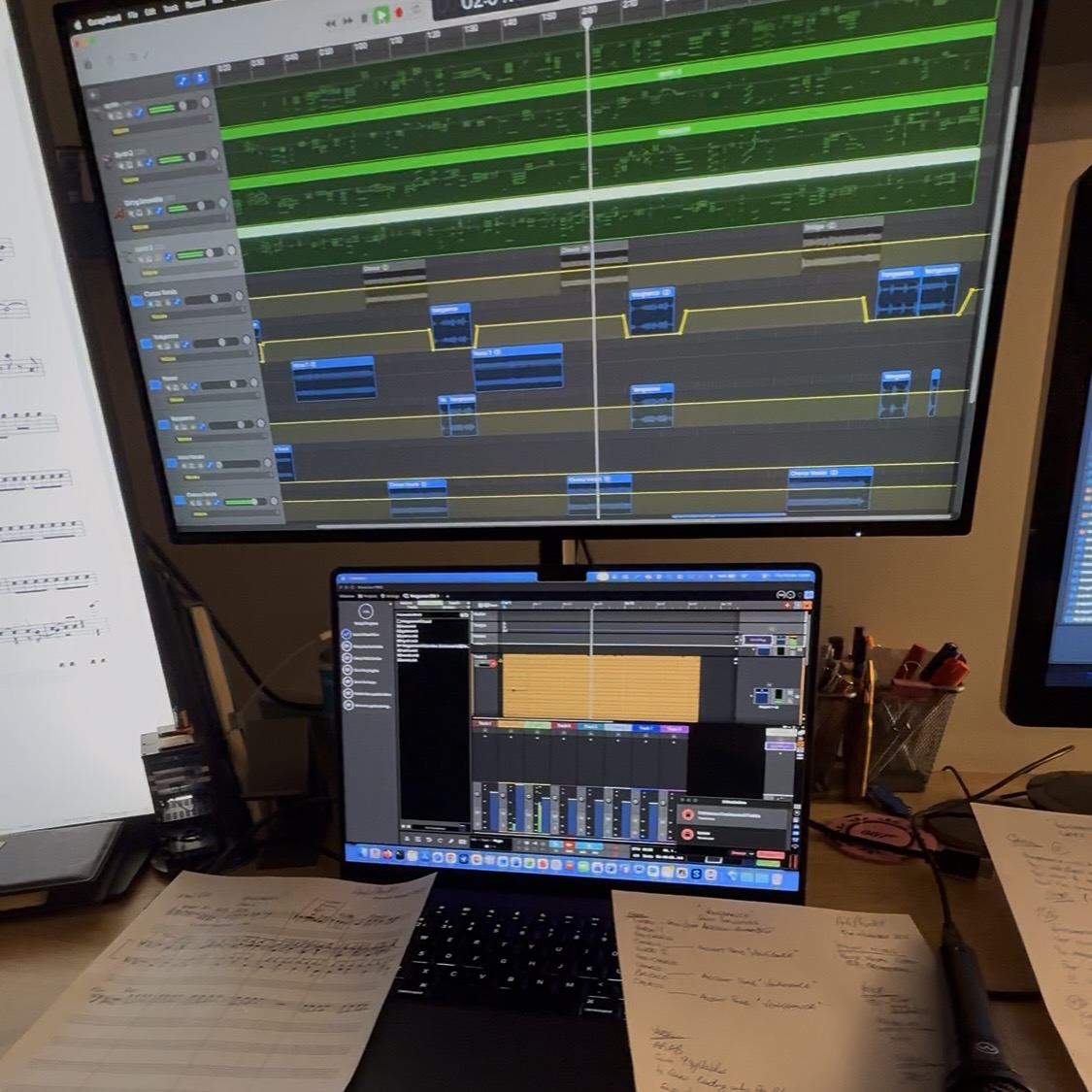
- The paper trail of authorship is the work itself: lyrics scribbled on paper, later developed into full songs; a few bars of a chorus handwritten in musical notation before transferring them into a DAW; hours of recorded experimentation; MIDI phrasing; and revision after revision.
- Someone waved a screenshot of an unknown detector at my lyrics and a mix, complete with its own warning that results may be mistaken. I don’t know what that tool measures and I’m not here to litigate mystery algorithms.
- I’m happy to share process, drafts, session work, and the choices behind the music. That’s the conversation.
- The real question is simpler: do you enjoy the track or not? Taste differs. If ArtiPhakt isn’t for you, that’s fine. There’s a lot out there to discover. I’ll keep making the work, and I’ll keep the receipts.
- And yes, there’s an irony in asking an AI tool to “prove” whether something is AI. These systems are trained on patterns. They can be useful in places, but they’re not a substitute for evidence, context, or honest discussion. Personally, I find working with AI (such as ChatGPT) kind of infuriating at times. It can be incredibly helpful, and then suddenly it’s like talking to someone who speaks confidently while also contradicting itself sentence by sentence. Tools are tools. They don’t get the final say.
So you are anti-AI then?
- No, not at all. AI is a tool and it has its place. I think it’s a bit like an electric drill: before it existed you drilled by hand, and when the electric one arrived, it didn’t erase craftsmanship, it changed what was practical.
- The use of AI in the creative arts is controversial, and some concerns are legitimate, especially around identity, consent, and reputation. If you’re a well-known actor or artist, you’d understandably want to prevent someone from cloning your persona and flooding the world with low-effort work.
- For everyone else, my view is simple: focus on the craft. Make things. Finish things. Let the work speak.
Name a few tools you lean on.
- For corrective tuning I’ll use Graillon 3 or MAutoPitch. For extreme time and pitch design I like PaulXStretch. I also write in more than one DAW, choosing the environment that fits the task: some are best for MIDI and MPE-centric performance, others shine for sampling, comping, and detailed editing. They’re all capable; I pick what serves the piece.
Let’s talk songwriting. Where does a song begin for you?
- It usually starts with a fragment: a tune, or a line or two of lyrics. Mix that with some late-80s/90s era computer-code discipline, and we start to get somewhere.
- In the late 80s and early 90s, both working solo and with a group, I wrote demos for the Atari ST and Amiga, showcasing those machines’ musical and visual capabilities. That work was either MIDI-based, or sample cut-and-mix. Those demos are still out there if you know where to look.
- ArtiPhakt is both an experiment and a project: I set out to explore music end-to-end, honing songwriting through to release. My taste is eclectic, everything from Jean-Michel Jarre to Ghost, and that wide listening bleeds into structure and timbre.
- I also had a long hiatus from active music-making, more than twenty-five years. The ideas never stopped: a few bars of melody, a drum beat, a single line of lyrics, sometimes just a concept. During the lockdowns, after a life-changing moment, I pulled those threads again. Some knitted together and became songs; many did not. I still revive pieces I once binned off and build them into finished work.
So do you play or just programme?
- Both, by design.
- I play: I grew up in ensembles on brass; euphonium, trombone, trumpet, learning blend, time, and dynamics the slow, disciplined way. I’m also learning drums. I’m not at live-set level yet, but on current work I’ve sampled my own kit and I sequence the drum parts in MIDI from those samples.
- I programme: Programming is performance at the grid. I write and edit parts in MIDI, shape articulations, humanise timing and velocity, layer synths, and build low-end architecture. For guitar-like lines I don’t pretend otherwise: I don’t play guitar. I perform those parts on a ROLI keyboard with ROLI Studio, using MPE-style pitch movement, bends, slides, vibrato, then refine or commit as MIDI. I checked one very fast, unreleased passage with a professional guitarist; he confirmed it’s playable on guitar as written, which tells me the phrasing translates for live players when I collaborate.
- Vocals: A blend of my early vocals, processed where needed, and professional session vocalists I work with now. Corrective tools are used when they serve the melody.
Did you study formally?
- Yes. I studied music as part of my education, sat the theory exam early, worked through higher practicals, and played in ensembles. I kept at it for well over fifteen years of focused learning and performing. Thousands of hours of practice, rehearsal, and study, easily into five figures. Composition, harmony, counterpoint, voice-leading, orchestration, and the discipline of leaving space do the heavy lifting in what I write now.
- I also cut my teeth in the classic Atari ST MIDI era with Steinberg Pro-series software that evolved into Cubase; the ST’s built-in MIDI taught a lot of us to think in tracks and timelines.
What are you working on right now? Walk me through the process.
- Luminara’s new album, Carnivale.
- The seed for Carnivale goes back to January as an early concept for Luminara’s first album. I wrote and developed several tracks, then decided Carnivale was the wrong introduction for the band and released Luminate first. As soon as Luminate was out I returned to Carnivale.
- Since June I’ve been deep in development. I resurrected tracks that were partial or fully formed, rewrote sections, and even dropped a few after recording vocals because they didn’t serve the concept. Carnivale is a concept album. The tracks exist to move the story forward, and a strong story frame still has to yield strong songs.
- After finishing two or three pieces I felt the music needed to hit harder. I unlocked a pattern of syllables, intonation, and melody that felt right, so I went back and rewrote, re-recorded, or reworked multiple songs.
- Two tracks, VeilBreaker and Oathbreaker’s Dance, were telling the same story from different viewpoints and timelines. Both were fully developed: lyrics, melody, recorded vocals. I shelved them, took the strongest elements from each and merged them into VowBreaker. It sings better. Hard to bin a full song; right decision.
- I also tested boundaries. Carnivale is meant to be edgier. I shared work-in-progress lyrics and drafts in a private WhatsApp group to sense-check taste and tone. One collaborator was sceptical until the double meaning landed. Others gave clear feedback that the lines didn’t overstep. I finalised the track.
- Where I am now: all vocals are recorded for the album. Mixing, editing, and refinement are in progress. I expect a few retakes as lines reveal better shapes in context. I’m the sole resource, so I’m also handling artwork and production decisions. I’m a vinyl fan, which means sleeve design, labels, sequence, and press specs sit next to the sessions on my desk.
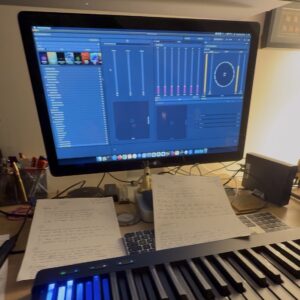
Roli Keyboard
Final word.
- I write for me. I find it cathartic. If you happen to like what I create, then great, I’m happy to have you along for the ride. If it doesn’t resonate with you, that’s fine too. The world is full of more music than anyone could ever hear. I’m sure you can find a band or musician that clicks, without feeling the need to hate on someone else.
No responses yet